
© Copyright 2000 Wealth International, Ltd.
NOTE: This report is presented with the understanding that the publisher is not engaged in rendering legal or accounting services. Questions relevant to the specific tax, legal, and accounting needs of the reader should be addressed to practicing members of those professions. This information was gathered from sources believed to be reliable but it can not be guaranteed insofar as it applies to any particular taxpayer. Wealth International, Limited specifically disclaims any liability, loss, or risk, personal or otherwise, incurred as a consequence directly or indirectly of the use and application of any of the techniques or contents of this report. No copies of this material may be made or redistributed without the express written consent of Wealth International, Ltd.
Why go diversify internationally? We enumerate our reasons piecemeal, but they are causally related. Their common root is the actions and machinations of government – a ubiquitous institution in our lives we would do well to relate to realistically. Government represents many things to many people, but it is undeniably parasitic in nature: Its members live off the output of the productive while returning as little as possible. That is not a value judgement; it is a useful metaphor. It is an accurate characterization of how things work in practice. A farsighted parasite would try to avoid weakening its host to the extent that its own well-being is jeopardized, but political systems are governed by perverse dynamics. They resist intelligent guidance and lack the feedback/response mechanisms that promote a return from the brink once that point is approached. Pressures can build up over time and eventually get out of hand, leading the system to crack under the burden.
“And now that the legislators and do-gooders have so futilely inflicted so many systems upon society, may they finally end where they should have begun: May they reject all systems, and try liberty.” ~~ Frederic Bastiat
It is a certainty that in a crisis a government will do all it can to ensure and justify its continued existence by exerting more control, rather than relenting on the laws and controls that are causing the problem. In critical instances new rules cause further breakdowns, which lead to new rules, which cause further breakdowns, and so on in a vicious cycle. We believe the current economic situation is in a slow motion version of this. The threat that it could careen out of control is very real. Thus the primary risk which moving a substantial portion of your assets to a foreign jurisdiction defends against is:
Other risks that moving a substantial portion of your assets abroad can defend you against, all of them entirely plausible, include:
 A rapacious body politic which begats a rapacious government. The value system which undergirds the cycle described above. Beyond performing government’s traditional role of transferring wealth from the politically unconnected to the connected – after a middleman’s cut – governments today are helping themselves to increasingly liberal portions of their subjects’ assets for their own account. Constitutional checks and balances and centuries-old human rights and legal traditions have been dispensed with in favor of expediency and greed, leaving the exploited class with little recourse against, in Ayn Rand’s turn of phrase, “the looters”.
A distinctly positive reason for looking internationally is the vast world of business and investment opportunities that is opened up. Many such opportunities are closed to, e.g., a U.S. person; thus taking advantage of the opportunities requires – yes – getting your assets out of your home jurisdiction. Now let us look a little deeper into the matter ...
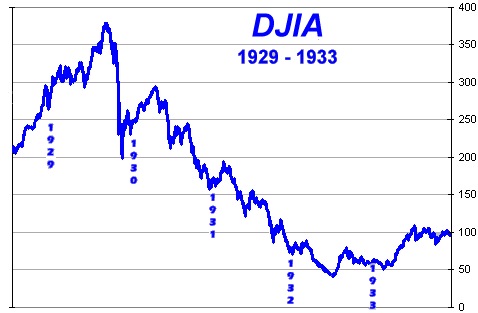 We see this as the most imminent risk to the financial well-being of the average reader. To be blunt, the danger of a severe economic contraction which could destroy a large percentage of your wealth is greater than any time since the worldwide depression of the 1930s.
Equivalent to pumping a pneumonia-ridden man with increasing doses of amphetamines to keep him going, Uncle Sam and his minions have repeatedly come up with string and baling wire solutions that enable the world economy to wheeze along, delaying the comeuppance that follows from massive and egregious policy errors. Every crisis since the 1960s has been papered over by increasing the systemic level of debt, public and private. But the resources expended to results achieved ratio keeps going up. The NASDAQ/dot.com mania of the late 1990s gave way to the far more dangerous real estate mania. In turn the effects of that crash have been temporarily held in abeyance by an unprecedented and appalling all-out government borrowing and money-creation binge. The system’s debt-carrying capacity may finally have been saturated, and the only Plan B which makes any sense – a return to fiscal sanity – is not on the table. When the music finally stops, the historical lesson is clear. Stocks, bonds, real estate, and most real assets, as well as economic and political liberty, experience significant bear markets.
A deeper examination of current background economic factors could lead one to conclude that an economic crisis that makes the 1930s look comparatively tame is in the cards. To say the U.S. macrofinancial situation looks precarious is to engage in gross understatement. Any further decline in confidence in the dominant world economy could lead to a collapse in economic activity, the dollar, the stock and bond markets, i.e., wealth. We are not alone in this outlook. Check out the commentary at sites such as The Daily Reckoning, especially articles by the late Dr. Kurt Richebächer and ranter extraordinaire “The Mogambo Guru” (Richard Daughty), or Prudent Bear to get an alternative perspective to the standard pap. Decide for yourself whether the events that they fear – which admittedly they have been warning about, Cassandra style, for years – are at least possible, and therefore worth insuring against.
There may be a more pressing risk still to consider, as even a “collapse” unfolds over time. The attacks of September 11, 2001 succeeded in closing the financial markets for a week. Another attack could conceivably close them down for much longer, if knowledgeably and expertly executed. (The reasoning behind accepting that this is a possibility is elaborated on here.) History shows how empires have terrorism and military risks that regular nations do not, and the U.S. is the only candidate for this appellation today. The consequences of a prolonged closure of the U.S. markets is difficult to imagine, but surely they are not ones that anyone would wish to subject themselves unprepared.
A treatise on investment strategy is beyond the scope of this report, but if the risks touched upon above are plausible then initial appropriate actions are clear. Start with an incisive assessment of your current situation. The perils to your wealth and assets do not just come from the markets as such. Governments consistently use a crisis as a cover to further limit freedoms and appropriate assets. Laws and plans authorizing government control or seizure of financial assets are already in place which could be put to use in such an event. The 1933 U.S. gold confiscation, and the lack of accompanying outcry or resistance, is a historical example of the use of such laws. (Holders of gold were forced to sell their holdings to the Federal Reserve for $20.67/oz. Gold was then revalued to $35.00/oz.) Before overt appropriation is resorted to it is reasonable to anticipate capital controls restricting the exchanging of dollars for other currencies and the moving of assets abroad – as occurred during World War II. Assets that remain within the U.S., immobilized within the system, would be vulnerable to inflation and future government decrees and actions. Numerous instances of this general course of action by governments render the plausibility of a future repetition beyond dispute.
The risks discussed above apply to everyone without exception, regardless of economic class, political ideology or affiliation. We believe that alone constitute a compelling reason to start internationally diversifying your financial assets, including jurisdictionally. Next, we detail the risks emanating from the leviathan that the U.S. legal/governmental complex has become. They provide a somewhat different motivation and entail additional methodologies to shield your assets. While the potential horror stories warned against may seem abstract and low probability, we submit that their potential is very real and, again, worth insuring against – provided this can be accomplished at a reasonable cost. Diversifying your financial holdings internationally is one element of a sound and cost-effective asset protection strategy.

The word “epidemic” is an overused but appropriate cliché for describing the proliferation of lawsuits in the United States. With over 50,000 lawsuits filed each week, the word fits. Not just coincidentally, most of the world’s lawyers live in the U.S. No claimant is unable to find an attorney to offer representation – if the target is sufficiently asset rich. Everyone with assets is a potential target, not just those in high-risk professions. And once you are in a litigant’s crosshairs it is easy to locate everything in your name in short order, as is discussed below.
“The dog with the bone is always in danger.” ~~ Chinese saying
 The U.S. Supreme Court has repeatedly failed to overturn these forfeiture laws when given the opportunity. (In one ruling, a dissenting Justice complained that the majority decision would imply that the government could seize an entire ocean liner if a single passenger unknowingly was allowed to bring one marijuana cigarette on board!) The seizing agency agency usually gets to keep most of the proceeds, creating an obvious corrupting motivation, as well as a powerful lobby against attempts to reform the forfeiture laws. As with those “reforms” concerning the IRS, marginal modifications to the laws do not evidence any real turn in the trend of increasing arbitrary government power and decreasing due process. “Someone has taken justice in this country and hidden it under the law,” goes a movie line.
In summary, the principles of human rights, due process, justice, fairness, consistency and logic, as people normally understand them, do not guide the agenda and rulings of the U.S. justice system, especially when one of the parties is the government. The guiding principle is force, which they have the overwhelming capacity to administer and are willing to use, often to excess. The judiciary was allegedly designed to be a check against legislative and executive branch power expansion. The reality is that the courts are part of the government and administer government rules. Every government employee has a direct pecuniary interest in maintaining a well-funded and intimidating government. Juries have historically been the last barrier and ultimate check against unrestrained government power. This is no longer the case – not even close. Judges’ instructions limit jurors’ discretion, and the juries are chosen with an eye to weeding out independent thinkers. And the chances are that half a given jury’s members will be dependent on direct or indirect government subsidies anyway.
 The demand for information by government agencies, commercial entities that treat their customers as “assets” to be milked like cows, and, now, identity thieves, shows no sign of moderating. The basis of emerging technology giants like Google and Facebook is information on people, and they have shown little discretion in reigning in their collection, storage, and often sharing of that information. We indeed have become a “database society”.
A recent search on the internet using the search-term “SSN” revealed that often for less than $100 the following information about you is readily available:
Most of this information is available within hours, if not more quickly, and can be obtained using one’s credit card right over the internet. Note that the common denominators necessary for finding this information are the numbers associated with your name and the property that you own. All of this information is available commercially. One can imagine what the government with its unlimited resources already knows or can find out about you. Proposed legislation that would have imposed greater restrictions on the sharing of collected information was substantively gutted by the lobbying of the affected corporations. Federal guidelines require the use of Social Security Numbers on Drivers Licenses going forward. Without some form of privacy protection, your life is transparent to anyone with a few dollars and a computer. Attacking your assets is a simple matter when they can be located so easily due to being held in your name and/or associated with your Social Security Number.
 While “1984” may have arrived a little later than the title of the famous novel implied, it is here now. In addition to the information above, considered private by most people, your credit record and a transaction-by-transaction record of your credit or debit card purchases are easily accessed. For frequent card users an intimate X-ray into the card owner’s life is easy to obtain. For instance, anyone thinking of issuing you a credit card or extending a loan can access that database. Of course any government employee will have no problem gaining access. Requiring more effort, but easy enough, is the gathering of transaction histories from checking accounts. Courts have repeatedly ruled that there is no right to privacy that extends to banking records. In effect, the banking system is a government agency and they can use their records as they see fit.
A not implausible conspiracy-ilk theory is that the cost of each checking transaction has been subsidized in order to encourage people to put their transaction records where they can be monitored. Now with the infrastructure in place the people are obviously being encouraged to make all transactions via debit or credit card, where they can be tracked in real time. No need to deal with all that inconvenient cash any longer! The total phasing out of easy-to-spend, hard-to-trace cash is only a matter of time.
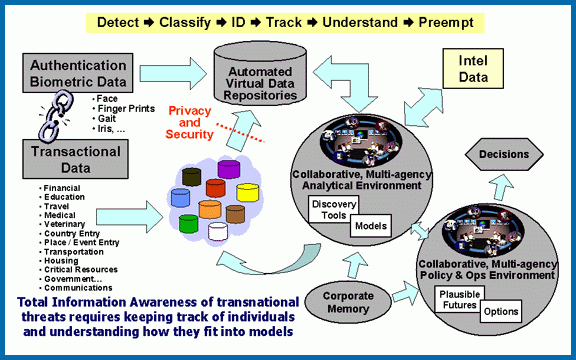
Meanwhile, proposals and laws too numerous to detail have followed the 9/11/2001 attacks and taken the onslaught on privacy to a new level of intensity. Any one person could be a terrorist, and any financial transaction could be supporting a terrorist operation, so the reasoning goes, and thus every person and transaction should be tracked and analyzed. Welcome to the Surveillance State. The image just above to the right is the old logo for the Defense Advanced Research Projects Agency (“DARPA”), part of the U.S. Department of Defense, “Total Information Awareness” project. The Latin phrase translates to “knowledge is power.” After a public outcry the project name was changed to “Terrorism Information Awareness,” the above logo was toned down, and the project was nominally defunded by Congress. Sure it was. It is now hiddened away in less visible parts of the government budget. Click on the logo to see what they had in mind for all of us. (As with the logo, that diagram is also no longer available on the DoD web site.)
An old Wall Street saw cum warning is: “Wall Street’s graveyards are filled with men who were right too soon.” In investing, your idea and your timing have to be correct. As Ernest Hemingway said “There is no premature anti-fascism,” there is also no such thing as “too soon” when it comes to insuring yourself against the risks we are discussing – only “too late.” Once you are sued, charged, or otherwise dragged into the judicial system it is too late to institute preemptive protective measures. Any transfers of assets to entities or locations seemingly safer from potential judgement can be ordered reversed, on pain of incarceration or further monetary penalty. Transfers of assets in order to escape an exisiting judgement (these days you could probably be charged on the basis that you suspected or should have known that you would soon be subject to a judgement) is called “fraudulent conveyance” and is itself a crime. Too late is exactly that ... too late.
 “Thinking about,” or ignoring or just living in fear of the potentialities recited above are ineffective. What is effective is to to take cost-efficient action, starting with investigation.
A Quick Test
We invite you to consider the following questions:
Draw your own conclusions here. You know your situation best. But as the number of affirmative answers and the income/asset numbers increase then, we think, the more relevant the concept of taking active measures to protect your assets becomes.
If you read the rest of this report you will be presented with tools with which one can:
| Previous | Table of Contents | Next |
 | ||